
from "The Twits" by Roald Dahl illustrated superbly by Quentin Blake


By Ophelia Benson and Jeremy Stangroom
Reviewed by Johann Hari - 02 July 2009
Authors Benson and Stangroom dismantle the logic of those who cite religion to justify the perpetuation of misogynistic abuses around the globe

A directory of divine misogyny
After all the arguments for subordinating women have been shown to be self-serving lies, what are misogynists left with? They have only one feeble argument that is still deferred to and shown undeserving respect across the world, even by people who should know better: “God told me to. I have to treat women as lesser beings, because it is inscribed in my Holy Book.”
Ophelia Benson and Jeremy Stangroom are the editors of Butterflies and Wheels, the best atheist site on the web. In Does God Hate Women? they forensically dismantle the last respectable misogyny. They argue: “What would otherwise look like stark bullying is very often made respectable and holy by a putative religious law or aphorism or scriptural quotation . . . They worship a God who is a male who gangs up with other males against women. They worship a thug.”
Every major religion’s texts were written at a time when women were regarded as little better than talking cattle. Their words and commands reflect this, plainly and bluntly. This book starts with a panoramic sweep across the world, showing – with archetypal cases – how every religion has groups today thumping women down with its Holy Book.
In Zamfara State in northern Nigeria, a pregnant 13-year-old girl called Bariya Ibrahim received 180 lashes of the cane in 2001 after being pimped by her father. The state’s attorney general said: “It is the law of Allah, so we don’t have anything to worry about.” In Jerusalem, ultra-Orthodox Jews have set up “modesty police” who terrorise young women who talk to men or show ordinary parts of their bodies. They break into their homes if they are seen with men; they force them to sit at the back of the bus, away from the men; and they even, in one recent instance, sprayed acid in the face of a 14-year-old girl.
In the areas of India still dominated by orthodox Hinduism, a widow is still expected to commit suicide when her husband dies, or go into isolation in an ashram. One – a septuagenarian woman named Radha Rani Biswas – fled and now begs on the streets of Vrindavan. She said: “My son tells me: ‘You have grown old. Now who is going to feed you? Go away.’ What do I do? My pain has no limit.” And on the directory of divine misogyny goes, running through Catholicism, Mormonism and more. Benson and Stangroom note: “Religion doesn’t necessarily originate ideas about female subordination, but it lends them a penumbra of righteousness, and it makes them ‘sacred’ and thus a matter for outrage if anyone disputes them.”
Methodically, they go through the excuses offered for these raw abuses of human rights by the religious, and their apologists.
The first – especially beloved of the Vatican and Islamists – is that women are not being treated worse, just “differently”. They claim that it accords a woman special “dignity” to trap her in the home. But this is an abuse of language. As the authors note: “Permanent consignment to a limited and lesser role in the world is not what ‘dignity’ is generally understood to mean . . . The smallness and intimacy and relatedness of home are fine things, but not if one is confined to them permanently.”
The religio-misogynists then claim that it is “racist” or “imperialist” to oppose such abuses. This merrily ignores how women within these cultures protest against their treatment – very loudly. They aren’t objecting to being imprisoned in their homes, or having their genitalia cut, or being stoned for having sex, because a white person told them to. Benson and Stangroom put it well: “Multiculturalism by definition makes a fetish of cultures, and it is almost impossible to do that without treating them as monolithic. As soon as you admit that all cultures have internal dissent and nonconformity, the whole idea of protecting or deferring to particular cultures breaks down into incoherence.”
Then the gentler, nicer apologists for religion arrive. They say that misogynists are simply misinterpreting the holy texts, which are in fact about love and compassion and kindness. But the authors point out this is certainly not the God of the texts who orders his followers to commit mass murder, including of women and children, and explicitly says women are inferior beings.
So, in order to defend their God, the apologists often have to lie about what He and His Prophets “say” in the texts. Cherie Blair, for example, claimed in a lecture: “It is not laid down in the Quran that women can be beaten by their husbands.” But it quite plainly is. The Quran says: “If you fear high-handedness from your wives, remind them [of the teachings of God], then ignore them when you go to bed, then hit them.”
Karen Armstrong – one of the most egregious defenders of superstition – repeatedly claims that Muhammad was an emancipator of women. Yet it is explained in the Hadith (the sayings and traditions of the Prophet) that he married a prepubescent child, and that when he was given two slave girls he gave the ugly one away to a friend and kept the beautiful one, Maryam, to use sexually. It is a strange model of female emancipation, to sleep with children and slaves.
There are people in all religions who have – through theological contortions – managed to leave behind literal readings of the text and invent a less foul God to believe in. It is not for atheists to say that one group of believers is right and the other is wrong, as we think they’re all wrong. We can note that the less literalist a believer is, the easier he is to live beside, but we will only discredit literalism and force reform if we are honest about the words of the texts, rather than trying to soft-soap believers.
By the end of this book-length blast, Benson and Stangroom have left religious hatred of women in rubble. Anybody not addled by superstition will have to conclude that such bigotry deserves neither respect nor deference. It does not deserve the taboos that today surround it. It deserves the opposite: contempt – and relentless, unyielding opposition.
Does God Hate Women?
Ophelia Benson and Jeremy Stangroom
Continuum, 208pp, £14.99
 Making radically changing life decisions can often be a process that often leaves us doubting, sleepless and paralyzed to do anything else.
 There is NO mystery to happiness.
 Unhappy men are all alike. Some wound they suffered long ago, some wish denied, some blow to pride, some kindling spark of love put out by scorn – or worse, indifference – cleaves to them, or they to it, and so they live each day within a shroud of yesterdays. The happy man does not look back. He doesn’t look ahead. He lives in the present.
But there’s the rub. The present can never deliver one thing: meaning. The ways of happiness and meaning are not the same. To find happiness, a man need only in the moment; he need only live for the moment. But if he wants meaning – the meaning of his dreams, his secrets, his life – a man must reinhabit his past, however dark, and live for the future, however uncertain. Thus nature dangles happiness and meaning before us all, insisting only that we choose between them.
EXCERPT FROM: INTERPRETATION OF MURDER BY JED RUBENFELD
On pages 9 and 10 of his book Bagombo Snuff Box: Uncollected Short Fiction, Vonnegut listed eight rules for writing a short story:
- Use the time of a total stranger in such a way that he or she will not feel the time was wasted.
- Give the reader at least one character he or she can root for.
- Every character should want something, even if it is only a glass of water.
- Every sentence must do one of two things -- reveal character or advance the action.
- Start as close to the end as possible.
- Be a sadist. No matter how sweet and innocent your leading
characters, make awful things happen to them -- in order that the
reader may see what they are made of.- Write to please just one person. If you open a window and make love to the world, so to speak, your story will get pneumonia.
- Give your readers as much information as possible as soon as
possible. To heck with suspense. Readers should have such complete understanding of what is going on, where and why, that they could
finish the story themselves, should cockroaches eat the last few pages.
- By Lev Grossman, Original Article Here.
The proper length for an obituary for Kurt Vonnegut is three words: "So it goes." This one will do what Vonnegut never did, which is go on too long.
"So it goes" is a phrase from Vonnegut's novel Slaughterhouse-Five, or The Children's Crusade. It's an expression the Tralfamadorians — a race of four-dimensional aliens — repeat whenever somebody or something dies. It expresses a certain airy resignation about the inevitability of death. Vonnegut — who died Wednesday night at the age of 84 from injuries suffered in a fall — had the Tralfamadorian attitude. "I've been smoking Pall Mall unfiltered cigarettes since I was 12 or 14," he told Rolling Stone last year. "So I'm going to sue the Brown & Williamson Tobacco Company, who manufactured them. And do you know why? Because I'm 83 years old. The lying bastards! On the package Brown & Williamson promised to kill me."
Vonnegut was born Indianapolis in 1922, the son of an architect. His early life shows the kind of aimless lateral peregrinations of someone who was in the process of inventing a kind of person that hadn't really existed before. He put in a mediocre stint at Cornell before enlisting in the army in 1942, in the teeth of World War II. Shortly afterward — and within a year of each other — two events occurred that would prove to be formative for Vonnegut. In 1944, on Mother's Day, he came home on leave to discover that his mother, an unsuccessful writer, had committed suicide with sleeping pills. In December of that same year Vonnegut was captured during the Battle of the Bulge and sent to Dresden as a prisoner of war. On February 13, 1945 Dresden was leveled in a massive Allied bombing assault so intense it created an enormously destructive firestorm. Well over 130,000 people died. Vonnegut survived by hiding in the basement of a slaughterhouse.
Perhaps because he began his writing career fully disillusioned, Vonnegut's view of the world changed very little over his five decades as an author. His first novel, Player Piano, was published in 1952 and set in a spiritually empty, hyper-mechanized future dystopia. (Vonnegut mixed literature with science fiction long before it was cool.) His most famous novel — his personal favorite, and the one that deals with most directly with the Dresden disaster — is Slaughterhouse-Five, the story of one Billy Pilgrim, a man who becomes "unstuck in time": Billy experiences the events of his life in random order, including his own birth and his own death. Understandably, this imbues him with a weird, almost redemptive fatalism, which is echoed by the narrator, who is Vonnegut himself. "There would always be wars," he writes, "they were as easy to stop as glaciers... And even if wars didn't keep coming like glaciers, there would still be plain old death."
Vonnegut's sincerity, his willingness to scoff at received wisdom, is such that reading his work for the first time gives one the sense that everything else is rank hypocrisy. His opinion of human nature was low, and that low opinion applied to his heroes and his villains alike — he was endlessly disappointed in humanity and in himself, and he expressed that disappointment in a mixture of tar-black humor and deep despair. He could easily have become a crank, but he was too smart; he could have become a cynic, but there was something tender in his nature that he could never quite suppress; he could have become a bore, but even at his most despairing he had an endless willingness to entertain his readers: with drawings, jokes, sex, bizarre plot twists, science fiction, whatever it took.
Vonnegut struggled with silence and depression — including a suicide attempt in 1984 — but in all he managed to publish 14 novels, three short story collections, five plays and five works of non-fiction. His last book, Man Without a Country, a collection of essays published in 2005, was a surprise best-seller.
Although he died a literary celebrity, lionized by the culture of which he was so unsparing, Vonnegut was always drawn to outcasts and failures in his writing: criminals, the deformed, the exiled, the damaged, the insane, anyone who no longer had a stake in repeating society's familiar lies. The cast of Cat's Cradle includes one of those outcasts, a midget to whom Vonnegut gave the title speech:
"No wonder kids grow up crazy," the midget says. "A cat's cradle is nothing but a bunch of X's between somebody's hands, and little kids look and look and look at all those X's..."
"And?"
"No damn cat, and no damn cradle."I stumbled into this at Boingboing.net first thing in the morning in between sips of coffee. It was so surreal I just had to blog it to have documentary proof come tomorrow that it was for real.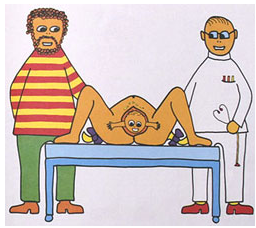
Per Holm Kudsen wrote a book entitled The True Story of How Babies Are Made and it is an illustrated children's book that has odd, graphic drawings. Frankly speaking, it was hilarious. And I rather thought it honest and effective in explaining the whole "the birds and the bees" thing. Kids won't find it nearly as funny though. Hee-hee.
If you want to see the entire content of the book, click this Link which has it in German. Make sure you click on the book images to turn its pages.
Having immense fun reading John D. Barrow's The Infinite Book. A sampler in which Barrow borrows from Frank Morgan (yes, you've heard versions of this before, tis a classic, but none so cunningly put):
Three guys go into a hotel, each with $10 in his pocket. They book one room at $30 a night. A short while later a fax from the headquarters directs the hotel to charge $25 a night. So the receptionist gives the bellhop $5 to take to the three guys sharing the room. Since the bellhop never got a tip from them and because he can't split $5 three ways, he decides to pocket $2 and give them each one dollar back. So each of the three guys has now spent $9 and the bellhop has $2 for a total of $29. Where's the extra dollar?"
Woo-hoo! (Yes, I can be a nerd.)
Ok, I'm throwing this in for Joseph who mentioned it. It's the case of the terminator 0, 1/2 and 1:
We have thus proven that when dealing with infinity, S can be any number.We begin with the infinite series S = 1 - 1 + 1 - 1 + 1 - 1 ...
which we can rewrite as: S = (1-1) + (1-1) + (1-1) + (1-1) +.. meaning S = 0but grouped differently: S = 1 + (-1 + 1) + (-1 + 1) +.. or S = 1 + 0 + 0 + .. thus S = 1
so we have proved that S = 0 and S = 1 thus if S = S then 0 = 1 !not only that, S = 1 - (1 - 1 + 1 - 1 + 1 - 1...) or S = 1-S or 2S = 1 meaning S = 1/2!

My grandfather picked me up. "Shall I throw you in, eh? Shall I throw you in the water?"
I shook my head. Adults are threatening creatures.
"Shall I throw you in the water?".."I'll put you in the rubbish bin.".. "I'll eat you all up.".. "I'll take you back and get another little boy."
That's what they say. And no matter how much you tell yourself that they're lying, or teasing, there's always a chance. Maybe they are telling the truth.
I had an aunt who claimed she had a tail, beneath her dress. I sneered at her, made sure she knew I knew she was lying; but secretly, I could not stop myself from wondering.
Adults lie, but not always.
When I was four, I believed everything, accepted everything, and was scared of nothing. Now I was eight, and I believed in what I could see and was scared of anything I couldn't. Scared of things in the darkness, of things invisible to see.
- from Mr. Punch by Neil Gaiman and Dave McKean
 remember the tart taste of the apples.


